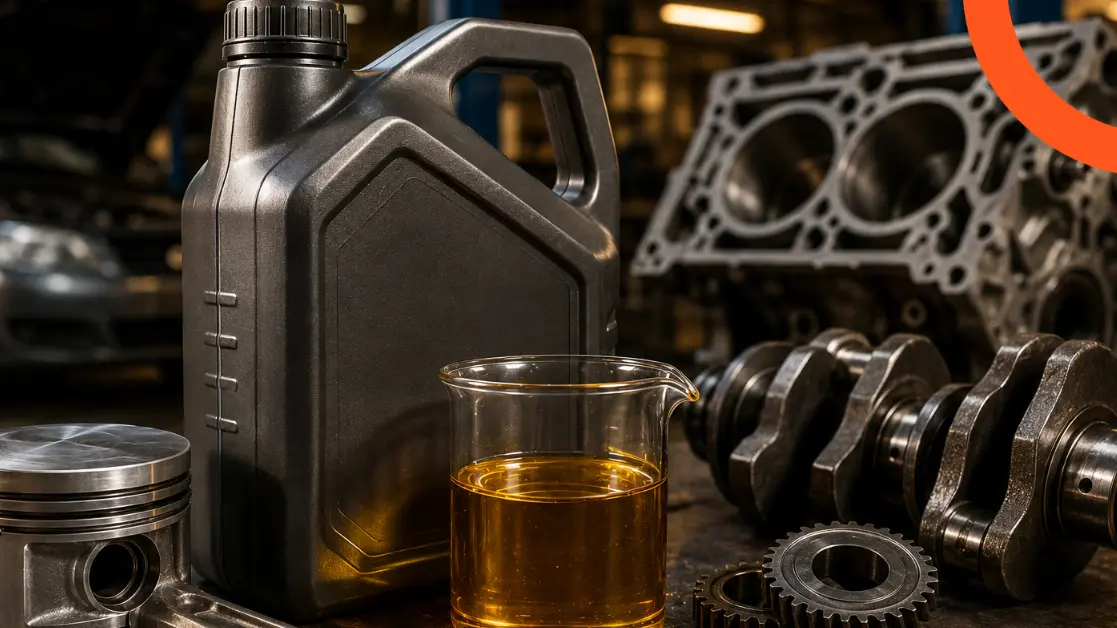
What Is Mineral Oil?
Mineral oil is one of the most commonly used engine oils for many years, and it remains a popular choice in many cars and industrial engines today thanks to its low cost and ease of production. However, the significant advancements in engine technology have led to the emergence of synthetic and semi-synthetic oils that provide higher levels of protection and performance.
In this guide, you will learn everything you need to know about mineral oil, from how it is made to the best situations for its use.

What does mineral oil mean?
Mineral oil is a lubricant extracted directly from crude oil after going through several stages of refining and purification to remove impurities and undesirable compounds. It is then blended with a group of additives to improve its properties such as wear resistance, oxidation prevention, and viscosity improvement.
Mineral oil is primarily used inside car engines to reduce friction between metal parts, assist in cooling the engine, protect it from wear and rust, and clean it from the deposits resulting from combustion.
This type of oil is the most economical option compared to other oils, which is why it is still used in older cars and some industrial and agricultural equipment.
How is mineral oil manufactured?

Mineral oil goes through several stages before it becomes suitable for use in engines.
The manufacturing stages include:
- Extraction of crude oil.
- Separation of petroleum derivatives in refineries.
- Refining base oils and removing impurities.
- Removal of unstable compounds.
- Adding performance-enhancing additives.
- Testing the oil before packaging.
Unlike synthetic oils that have their molecules manufactured in the lab, mineral oil retains its natural composition from crude oil, which explains the difference in its properties and performance.
What is mineral oil composed of?
Mineral oil consists of two main components:
- Base oils extracted from crude oil.
- Chemical additives that enhance performance.
In most commercial products, base oils make up about 75% of the formulation, while the added materials represent about 25%, and include:
- Antioxidants.
- Anti-wear agents.
- Detergents.
- Anti-foaming agents.
- Viscosity enhancers.
- Rust inhibitors.
Complete specifications of mineral oil
Mineral oil has a set of properties that distinguish it from other types of oils:
1. Source of manufacturing
It is extracted directly from crude oil after refining and purification processes without manufacturing its molecules in laboratories.
2. Nature of molecules
Mineral oil consists of hydrocarbon molecules that are heterogeneous in size and shape, therefore, its ability to resist heat is lower compared to synthetic oils with uniform molecules.
This difference leads to:
- Rapid degradation of the oil.
- Lower thermal stability.
- Change in viscosity with usage.
3. Density
The density of mineral oil typically ranges between 0.80 to 0.87 g/cm³
It varies slightly according to the manufacturer and viscosity grade.
4. Viscosity
Viscosity is the oil’s ability to form a protective layer between engine parts. Some of the most common viscosity grades available for mineral oil are:
- 10W-30
- 10W-40
- 15W-40
- 20W-50
The viscosity grade is chosen according to the recommendations of the engine manufacturer.
5. Thermal performance
Mineral oil works efficiently at moderate temperatures, but is significantly affected in extreme conditions.
When temperatures rise:
- Viscosity decreases.
- Oxidation rate increases.
- The oil begins to degrade gradually.
In extremely cold conditions:
- It becomes thicker.
- It needs a longer time to reach engine parts.
- The lubrication efficiency decreases during cold starts.
6. Chemical stability
Mineral oil is more susceptible to reacting with oxygen compared to synthetic oils. Over time, this leads to:
- Formation of deposits.
- Change in oil color.
- Decrease in lubrication efficiency.
- Increased oil consumption.
7. Service life of the oil
One of the most prominent characteristics of mineral oil is that its lifespan is shorter than other types. Therefore, it is usually recommended to change it every:
3,000 to 5,000 kilometers
This distance may decrease under harsh driving conditions or high temperatures.
How does mineral oil work inside the engine?
Mineral oil performs several essential functions, the most important of which are:
- Reducing friction between moving parts.
- Cooling engine parts.
- Cleaning the engine from deposits.
- Protecting metals from rust.
- Reducing wear.
- Assisting in sealing piston rings.
Therefore, the quality of the oil directly affects the engine’s lifespan and efficiency.
When is mineral oil suitable?

Despite significant advances in engine oil production, mineral oil is still a suitable option in many situations, especially when performance requirements are limited or when the manufacturer recommends its use.
Mineral oil is recommended in the following situations:
- Older cars with traditional engines.
- Engines that have covered long distances and have high oil consumption.
- Daily driving in cities for short distances.
- When maintenance cost is an important factor.
- Vehicles that do not operate under high loads or continuous high temperatures.
If the car is modern or equipped with a turbo engine or operates in harsh conditions, it is better to use semi-synthetic or fully synthetic oil if recommended by the owner’s manual.
When is the use of mineral oil not recommended?
There are situations where using mineral oil is not suitable, including:
- Modern cars with high-performance engines.
- Turbo engines.
- Continuous long-distance driving.
- Driving in extremely high temperatures.
- Performance driving or high-speed driving.
- When the manufacturer requires the use of synthetic oil.
In these cases, mineral oil may not provide the necessary protection, potentially leading to increased wear or decreased engine efficiency over time.
Comparison between mineral oil and other oils
| Type | Manufacturing Method | Change Interval | Thermal Performance | Cost | Best Use |
|---|---|---|---|---|---|
| Mineral Oil | Extracted from crude oil | 3,000 – 5,000 km | Acceptable | Low | Older Cars |
| Semi-synthetic Oil | Mixture of mineral and synthetic | 7,000 – 10,000 km | Good | Medium | Most Daily Cars |
| Fully Synthetic Oil | Lab manufactured | 10,000 – 15,000 km or more depending on manufacturer recommendations | Excellent | High | Modern Cars and Turbo Engines |
The difference between mineral oil and synthetic oil
Some believe the difference between the two types is limited to price, but in reality, the difference includes manufacturing method, performance, and shelf life.
| Element | Mineral Oil | Synthetic Oil |
| Source | Crude Oil | Lab Manufacturing |
| Molecule Structure | Irregular | Homogeneous |
| Heat Resistance | Medium | Very High |
| Oxidation Resistance | Lower | Higher |
| Viscosity Change | Changes Quickly | More Stable |
| Shelf Life | Short | Long |
| Deposit Formation | Higher | Lower |
| Price | Low | Higher |
For this reason, most modern cars rely on synthetic oils for optimal engine protection.
Advantages of mineral oil
Mineral oil has several advantages that make it suitable for certain user categories, including:
- Its low price compared to other types.
- Available from most oil companies.
- Suitable for older engines.
- Provides good lubrication under normal operating conditions.
- Easy to replace and has low operational costs.
- Suitable for some industrial and agricultural equipment.
Disadvantages of mineral oil
Despite its advantages, mineral oil has some disadvantages that should be considered:
- Short shelf life.
- Oxidizes quickly.
- Requires frequent changes.
- Efficiency decreases with high temperatures.
- Becomes thicker in cold weather.
- May leave carbon deposits inside the engine over time.
- Not suitable for most high-performance modern engines.
Tips for using mineral oil
If you use mineral oil, there are a few tips that can help maintain engine efficiency:
- Stick to the recommended oil change intervals.
- Change the oil filter with every change.
- Monitor the oil level periodically.
- Use the appropriate viscosity grade for your car’s engine.
- Avoid extending the oil usage period after its lifespan has ended.
- Do not mix different types of oils unless permitted by the manufacturer.
Conclusion
Mineral oil is a lubricant extracted from refining crude oil, characterized by its low cost and widespread use in older cars and industrial equipment. Although it provides good protection under normal operating conditions, its short lifespan and rapid heat sensitivity make synthetic oils a better option for most modern vehicles.
Therefore, choosing the right oil depends not only on price but also on the type of engine, driving nature, manufacturer recommendations, and adherence to recommended oil change intervals.
FAQs
What is meant by mineral oil?
Mineral oil is a lubricant extracted from crude oil after refining, and it is used to reduce friction inside engines and protect them from wear.
What are the specifications of mineral oil?
It consists of base oils with additives, and its density usually ranges between 0.80 and 0.87 g/cm³, available in several viscosity grades such as 10W-40 and 20W-50.
What is the difference between mineral oil and synthetic oil?
Mineral oil is extracted from crude oil with irregular molecules, while synthetic oil is made in a lab and offers higher stability, longer life, and better heat resistance.
What is the duration for changing mineral oil?
It is generally recommended to change it every 3,000 to 5,000 kilometers, or according to the manufacturer’s recommendations for the vehicle.
Is mineral oil suitable for modern cars?
In most cases, no, because modern engines often require synthetic oils that provide better protection and stability.
How can I tell if the oil is mineral or synthetic?
This can be determined from the label on the oil container or the car owner’s manual, where the type of oil is clearly specified.
What are the most common viscosity grades of mineral oil?
Some of the most common viscosity grades of mineral oil are: 10W-30, 10W-40, 15W-40, and 20W-50, and the appropriate grade should be chosen based on the manufacturer’s recommendations for the engine.
Does mineral oil withstand high temperatures?
It can withstand moderate temperatures, but it quickly loses part of its properties when exposed to high temperatures for long periods compared to synthetic oils.
What are the main disadvantages of mineral oil?
Its main disadvantages include a short lifespan, rapid oxidation, the need for frequent changes, and reduced efficiency in harsh conditions.
Can I switch from mineral oil to synthetic oil?
Yes, in most cases, switching is possible, but it is advisable to adhere to the manufacturer’s recommendations and ensure the new oil is compatible with the engine specifications.
Can mineral oil be mixed with synthetic oil?
This can be done in some emergency situations, but it is not an ideal choice, as mixing oils may reduce the efficiency of the chemical additives. It is always preferable to use one type matching the manufacturer’s recommendations.
Is mineral oil suitable for long distances?
It is not the best option, as its lifespan is shorter and it is affected by heat more quickly, making synthetic or semi-synthetic oils more suitable for long trips.